

More freedom, with the finish of a factory installation
The brief for this MAN TGE based Adria TwinMax 680 SGX was straightforward: give the customer more freedom to use their campervan away from electric hookup, with enough onboard power to support everyday life and the addition of air conditioning. Just as important was how the installation would look and how much usable storage would remain.
At Vanbitious, we worked with the customer to plan an electrical upgrade around the way they wanted to use their Adria. The result brings together 460Ah of Fogstar lithium battery capacity, a Victron MultiPlus-II 12/3000/120-32 inverter/charger, upgraded alternator and solar charging, and a black Truma Aventa Comfort Gen 2 roof mounted air conditioning system.
The starting point
This particular Adria arrived with two 100Ah AGM leisure batteries, an 85W Dometic solar panel and no onboard inverter. A skylight occupied the roof position chosen for the new Truma air conditioning unit.
The customer wanted a more capable electrical system for supplying power throughout the vehicle while travelling and staying off grid. Increasing battery capacity was part of the solution, alongside providing 230V power from the leisure batteries and improving the ways those batteries could be recharged.
Designed around the customer and the Adria
Finding the right home for each component was an important part of the project. Having worked on Adrias before, we have previously installed an inverter in the storage cupboard beneath the fridge. For this customer, keeping that cupboard available for storage and maintaining the original interior finish took priority.
We agreed an alternative layout, keeping the replacement batteries in the original battery location, positioning the inverter in the underbed storage compartment and using the space beneath the driver's seat for the charging equipment. Each part of the installation had a considered place within the vehicle.
460Ah of Fogstar lithium power
We replaced the original pair of 100Ah AGM batteries with two Fogstar 230Ah Seat Base lithium leisure batteries, giving a combined nominal capacity of 460Ah. Both batteries fit within the space previously occupied by the original battery bank.
The compact Seat Base format made it possible to increase capacity while retaining the existing battery location. Although the product is designed around restricted installation spaces, its usefulness extends beyond fitting beneath a seat, as this installation demonstrates.
The new bank provides 2.3 times the original nominal amp hour capacity. That figure compares the batteries' stated capacities. Actual available energy and time between charges depend on the battery operating limits, state of charge and the equipment being used.

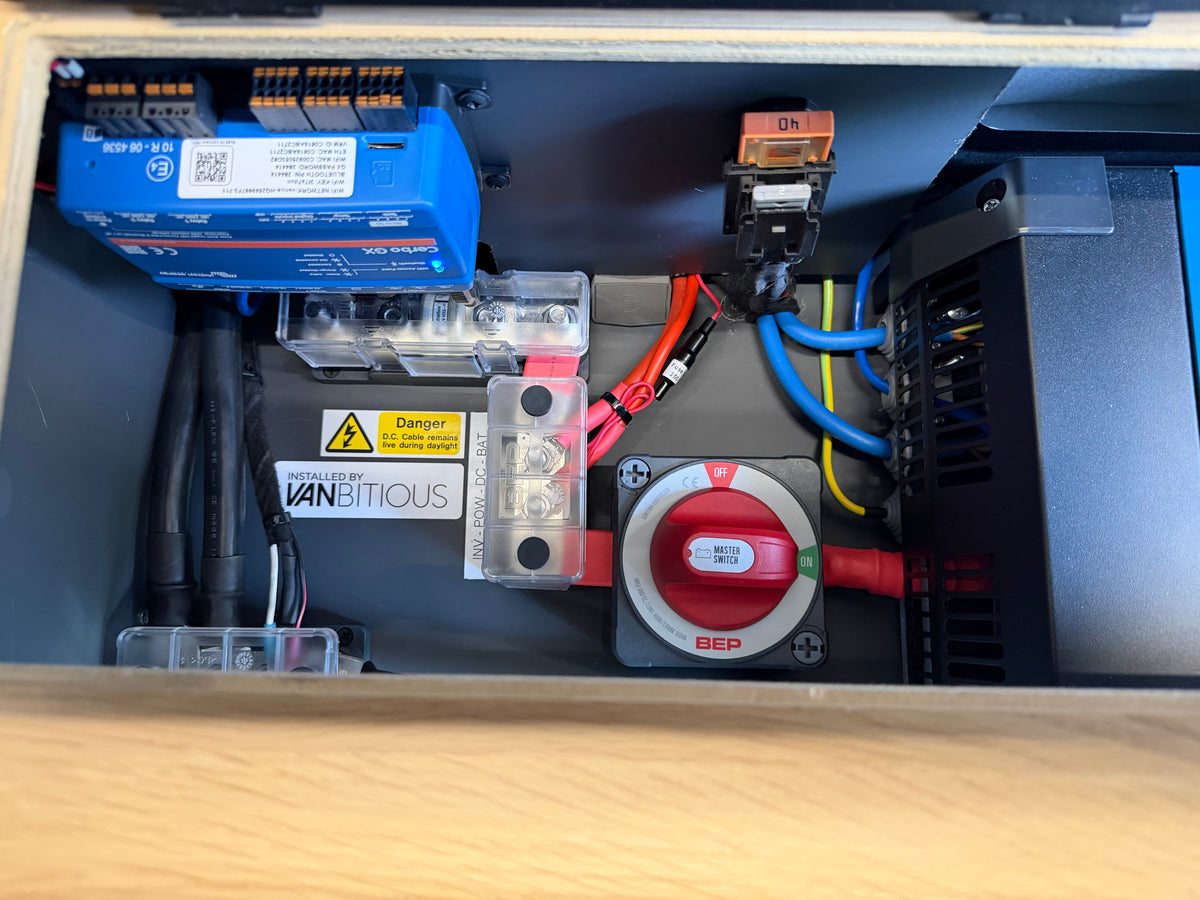
Victron MultiPlus-II 12/3000/120-32 inverter/charger, neatly tucked away
With no inverter fitted originally, adding a Victron MultiPlus-II 12/3000/120-32 inverter/charger introduced the ability to produce 230V AC power from the leisure battery bank. This supports the customer's aim of using mains powered equipment away from electric hookup, within the limits of the installed system.
We installed the inverter in the underbed storage compartment, keeping it discreetly positioned and preserving the cupboard beneath the fridge. The installation reflects the customer's preference for an interior that continues to feel like an Adria, with the upgraded equipment integrated into the available spaces.
The MultiPlus-II combines a 3000VA pure sine wave inverter with a battery charger rated up to 120A and a 32A transfer switch. It can supply connected appliances from the batteries away from hookup and recharge the battery bank when a suitable mains supply is available. Its continuous inverter output is rated at 2400W at 25°C, with the charging current and input limit configured to suit the installation and available supply.

The electrical equipment is neatly integrated into the underbed compartment.

Purposeful charging, with a factory look
The upgrade also included a Victron Orion XS 1400 DC to DC charger and a Victron SmartSolar MPPT 100/30 solar charge controller. These perform two different jobs: the Orion manages charging from the vehicle while the engine is running, while the SmartSolar manages the energy collected by the roof panel.
To install both units neatly, we manufactured a mounting plinth from black hex birch plywood beneath the driver's seat. This gave the equipment a clean, deliberate mounting arrangement that sits comfortably alongside the vehicle's original installation.
Victron Orion XS 1400 charging
A dedicated DC to DC charger controls the charging supplied from the vehicle electrical system to the leisure batteries. The Orion XS 1400 supports adjustable charging current up to 50A and operation with 12V and 24V systems. In this Adria it serves the 12V leisure battery system. Configurable charging settings and Bluetooth access through VictronConnect allow its operation to be set up for the installation and viewed from a compatible phone.
Victron SmartSolar MPPT 100/30
The SmartSolar MPPT 100/30 regulates the solar input to charge the leisure batteries. Maximum Power Point Tracking adjusts to the panel's operating conditions to make effective use of the available solar energy. Bluetooth connectivity through VictronConnect also provides a convenient way to view charging information.

From 85W to 200W of rooftop solar
On the roof, we removed the original Dometic 85W solar panel and fitted a Renogy 200W ShadowFlux panel, paired with the new Victron SmartSolar controller.
The change increases the stated solar panel rating by 115W, giving approximately 2.35 times the original rated output. In practice, solar production varies with sunlight, season, shading and panel temperature, so the wattage on the label is a rated figure rather than a constant charging output.
The larger panel provides a useful contribution to replenishing the battery bank when conditions allow. High demand equipment such as air conditioning still needs an energy budget that accounts for battery capacity and the charging available during the trip.
Truma Aventa Comfort Gen 2 in black

We removed the skylight at the chosen roof position and installed a Truma Aventa Comfort Gen 2 air conditioning unit with a black external housing. The dark finish complements the Adria's exterior, while the internal air distributor sits neatly within the existing ceiling layout.
The Aventa Comfort Gen 2 provides 2500W of cooling capacity and incorporates a heat pump with a stated heating output of 2000W. Its variable compressor and night mode are designed to help manage noise and comfort. These are cooling and heating output figures, rather than the electrical power drawn from the batteries.
Combining air conditioning with the upgraded battery bank and inverter makes cooling away from electric hookup possible, subject to the system's operating limits and available charge. Runtime depends on the outdoor temperature, temperature setting, compressor demand, battery state of charge and any other appliances in use. We discuss these practical expectations with customers when planning an upgrade.

Every detail earns its place
The larger battery bank and new equipment are only part of the story. Keeping the original battery location, retaining the cupboard beneath the fridge and manufacturing a dedicated plinth for the charging equipment helped preserve the appearance and practicality of the Adria.
The finished upgrade gives the customer greater flexibility to travel and stay away from hookup, with more onboard battery capacity, inverter supplied 230V power, upgraded charging and the comfort of Truma air conditioning.
Planning an Adria electrical upgrade?
If you would like more from your Adria's onboard electrical system, Vanbitious can help plan an installation around your vehicle, the appliances you want to use and the storage you want to keep. From lithium batteries and Victron equipment to solar and air conditioning, we focus on a considered installation that works with your campervan.
Get in touch with Vanbitious to discuss your electrical upgrade.
Share:
A New Kind of Shelter – Vanbitious Builds Aberdeen’s First Electric Safe Space on Wheels